
LACTUSAN: comfortable therapy - lasting results!
Bloating, pain, bad breath, general weakness, disorders in the digestive tract - this is just a partial list of problems that often begin to bother patients after a course of antibiotic therapy. But what to do, you say, not to be treated at all? Let's look at this question from the other side. Antibiotic therapy, of course, does its good deed in relation to the elimination of pathogenic microorganisms, which, in fact, are the cause of the underlying disease. However, numerous studies have shown that the mechanism of action of antibacterial drugs is not only the inhibition of pathogenic microflora. It is so non-selective that along with pathogenic microorganisms, beneficial bacteria are also destroyed, which are designed to guard the immune system of the gastrointestinal tract and the whole organism as a whole. So, let's see why we need useful microflora so much? To begin with, the intestines are normally inhabited by various microorganisms that perform vital functions for the body as a whole. These microorganisms are called the normal microflora (normal flora) of the intestine. The most famous representatives of the normoflora are bifidobacteria and lactobacilli, but in addition to them there are anaerobic streptococci, E. coli, enterococci, etc. All of them exist in a well-organized, interdependent community, balanced in quantitative and qualitative composition.
Why is the normal intestinal microflora so important and what functions does it perform?
Actively participates in metabolism
- Participates in the breakdown of complex organic substances (fats, proteins, cellulose).
- Enhances the action of digestive enzymes.
- Regulates lipid (cholesterol) levels.
- Participates in the process of recirculation of bile acids.
- Synthesizes amino acids (tyrosine, tryptophan, arginine, cysteine, etc.),
- vitamins (B, K, C), hormonally active substances (steroids, norepinephrine),
- antioxidants (vitamin E, glutathione),
- biogenic amines (histamine, serotonin, gamma-aminobutyric acid).
- Promotes intestinal absorption of calcium, vitamin D and iron.
- Participates in the regulation of homeostasis (maintaining the constancy of the internal environment of the body).
Along with immunity, it performs protective functions for the body
- It detoxifies the body and removes endogenous and exogenous toxic compounds.
- Suppresses putrefactive and other pathogenic flora.
- Stimulates local intestinal immunity through the synthesis of immunoglobulins.
- Has immunomodulatory properties.
- It has antimutagenic and anticarcinogenic (antitumor) effects (for example, butyric acid prevents the appearance and growth of a cancerous tumor of the rectum).
- It has an antiviral effect (in particular, it inhibits the reproduction of herpes viruses and cytomegaloviruses).
Trophic functions
- It is an independent source of energy.
- Regulates microcirculation in the intestinal mucosa.
- Regulates the process of regeneration of the epithelium of the large intestine.
From the foregoing, we can conclude that any disturbances in the composition of the normal microflora of the gastrointestinal tract will contribute to a number of disorders, one of which is intestinal dysbacteriosis.
What is intestinal dysbiosis?
Intestinal dysbacteriosis - a change in the quantitative and qualitative composition of its microflora, which entails a number of painful changes throughout the body, from the most seemingly insignificant at first to extremely severe later.
Consequences of intestinal dysbacteriosis
- Pathogenic microflora is actively developing.
- Many nutrients and minerals are poorly absorbed.
- Detoxification of toxic metabolites formed during digestion is impaired.
- Pathogenic bacteria also release a large amount of toxins, which, being absorbed into the blood, again, increase the load on the liver.
- The thermal supply of the body is disturbed.
- The energy supply of the colonic epithelium is reduced.
- The synthesis and supply of vitamins to the body (B12, pantothenic acid, etc.).
- Antiviral protection decreases, antitumor surveillance weakens, local immunity is disturbed.
Therefore, a very important task is to restore the disturbed balance in the intestinal microflora in time. For this purpose, prebiotics are widely used. And one of the most studied, effective and safe prebiotics is lactulose, which serves as a source of nutrition for bifidobacteria and lactobacilli, which are the basis of the obligate intestinal microflora. Being just a modification of ordinary milk sugar, lactulose has the ability to selectively stimulate the growth and vital activity of beneficial bifidus and lactobacilli, that is, lactulose is indifferent to pathogenic microorganisms and biologically active to beneficial bacteria, which is the fundamental goal in complex therapy! What is the reason for such selective action of lactulose? Lactulose is an indigestible β-glycoside carbohydrate. Due to the lack of appropriate enzymes in humans, it is not hydrolyzed (not split) in the upper sections of the gastrointestinal tract. Lactulose enters the colon unchanged, where it is cleaved under the influence of the colon flora (bifidobacteria and lactobacilli) with the formation of low molecular weight organic acids, which leads to a decrease in the pH of the intestinal contents. 
HISTORY OF THE DISCOVERY OF LACTULOSE
Lactulose was discovered by the Austrian pediatrician Petueli. In 1948, finding out the cause of dysbacteriosis in children fed artificial nutrition, he isolated from the composition of human milk a substance that activates the growth of the protective intestinal microflora (bifidus and lactobacilli) and called it lactulose.Further studies by his followers showed that when an infant was fed with conventional infant formula or milk, the content of bifidobacteria in the fecal microflora was 20 %. However, when 2 % of lactulose was added to baby foods, the bifidobacteria index increased to 90 %. One of the modern drugs on the pharmaceutical market of Ukraine, which include lactulose, is Lactusan(Felicity Ukraine). Issued Lactusan in a convenient form of syrup containing lactulose not less than 36 %, lactose not more than 13 %. Given that lactulose is 2 times less sweet than sucrose, the syrup, moreover, tastes good, which is important when used in children from a year old! 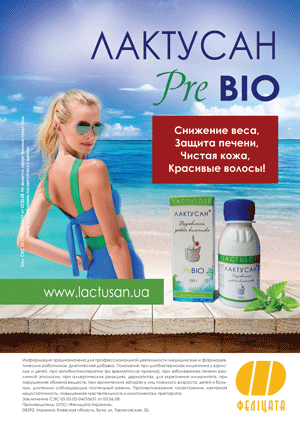 Normalizing the quantitative and qualitative composition of the intestinal bacterial flora, Lactusan prevents the reproduction of pathogenic microflora and translocation of intestinal bacteria; improves digestion and metabolism, normalizes the absorption of vitamins, increases immunity and overall body resistance. Besides, Lactusan helps to eliminate constipation and restore the physiological rhythm of bowel movements by stimulating colon peristalsis, increasing intracellular osmotic pressure, and increasing the volume of intestinal contents. Under the influence Lactusanand the absorption of ammonia by the colon and its excretion from the body increases, the growth of acidophilic bacteria (including lactobacilli) is stimulated, the reproduction of proteolytic bacteria is suppressed and the formation of nitrogen-containing toxic substances released by the proteolytic flora and playing an important role in the pathogenesis of hepatic encephalopathy decreases. The fact is that in an acidic environment most of the ammonia is in the ionized form (NH4+) and is poorly absorbed into the blood, and the alkaline environment increases the formation of a non-ionized, more lipophilic and better absorbed form of ammonia NH3. Thus, the action of lactulose leads to a decrease in the level of ammonia and other toxic products of protein decay in the blood. Due to this Lactusan may also be recommended for the treatment of hepatic encephalopathy, acute and chronic liver failure, alcoholic liver disease, when the ability of the liver to detoxify ammonia is impaired. Numerous studies have noted the beneficial effect of lactulose concentrate on the restoration of the intestinal microflora in mice, even against the background of the introduction of antibiotics such as ampicillin or tetracycline. Specialists of the Yaroslavl State Medical Academy found that lactulose concentrate in vitro contributes to an increase in the intensity of growth of bifidobacteria and lactobacilli. At the same time, the activity of lysozyme, a substance that plays an important role in the work of local immunity, also increased. Later, other positive properties of lactulose concentrate were noted. In particular, against the background of adding Lactusanand to the treatment regimen for patients with thyrotoxic goiter, diabetes mellitus type I and II, diseases of the digestive system, the indicators of the immune system normalized - the level of T- and B-lymphocytes, the synthesis of immunoglobulins, and the phagocytic activity of neutrophils increased. In light of the above, Lactusan recommended for use:
- when correcting the effects of antibiotic therapy;
- with intestinal dysbacteriosis in adults and children of varying severity;
- with liver diseases of various etiologies;
- with chronic constipation in the elderly, children, pregnant women, as well as in patients who are on bed rest for a long time;
- with colitis and other diseases of the gastrointestinal tract;
- with salmonellosis and to protect against intestinal infection;
- with renal failure;
- with toxicosis of pregnant women with functional digestive disorders;
- with allergic reactions;
- to activate the intestinal immune system.
Recommendations for use: in the diet to normalize the intestinal microflora (including after the use of antibiotics) with dysbacteriosis; with constipation; with liver diseases of various etiologies; with metabolic disorders accompanied by allergic dermatosis; to strengthen immunity. With dysbacteriosis: for adults, 2 teaspoons of syrup 2 times a day; children over the age of 3 years - 1 teaspoon of syrup per day; children from 1 to 3 years old - 0.5-1 teaspoon per day. Duration of admission - 7-14 days. For constipation: adults 2 tablespoons 1 time per day (with prolonged chronic constipation, the dose can be increased to 4 tablespoons); children over the age of 1 year - 1-2 teaspoons 1 time per day.
 Mamedova S. A., cand. farm. Sciences., NUPh
Daria Kutakh Press Service of APTEKA Weekly
Add Comment